Friday, 17 of April of 2026

Warrior Spirit

Warrioress
 
warriorTeach a class for poets who aspire to be warrior poets. A lot of it involves physical training, martial arts and meditation practice.

Then come back to the poetry, and appreciate it for the first time.

In martial arts you learn a series of movements; this is like learning forms in poetry. The practice of each, breath in, breath out, involves breathing. Breathing keeps the mind centered, the body aware.

The warrior takes care of her weapons so they will take care of her. The warrior poet does the same, taking special care to master the forms. Warrior-spirit is what links martial artist and warrior poet.

The clans of warrior poet and warrior both are marked by warrior spirit.

~Dennis Fritzinger


Bill Yake’s Review of The Ecopoetry Anthology

The Green, the Gray, and the Mottled, A Review of The Ecopoetry Anthology, 2013. Edited by Ann Fisher-Wirth and Laura-Gray Street, introduction by Robert Hass. Trinity University Press, San Antonio, Texas.
 
ecopoetry

Probably against my better judgment I read this anthology, over the course of several months, front-to-back, cover-to-cover, blurbs-to-credits. I feel obliged to provide an account of findings — whether it serves as an invitation or as a warning.

I’m drawn to the poetry of ecological-environmental-evolutionary concerns and figured this sprawling 628-page tome (occupying a full 1 15/32″ of shelf space — the width, incidentally, of a #24 stopper), including the works of 208 poets — while clearly not a paragon of concision — would provide a comprehensive overview of the best poets and poems of the field; and that it would turn up some valuable discoveries.

There were useful discoveries, yes, but finding them required wading too many unnecessary pages, often filled with mediocre and sometimes painful poetry.

Anthologies inevitably provoke opinions and raise hackles: perceived errors of inclusion, exclusion, and relative weighting — all the judgments that choices trigger. This review follows that honored tradition. I admit to general preferences for the succinct over the meandering, the poetry of knowledge over the poetry of whimsy and obscurity, the vivid image over the bland declaration.

So… Having reached the age at which seeking favor and defending one’s reputation aren’t worth the effort, I’ll dive in:
 
 
The Valuable Discoveries (or confirmations of previous discoveries): The anthology contains much admirable, impressive work. Poems to recommend to your best friends are:

Ralph Black whose 21st Century Lecture proceeds from despair to full-body engagement

Elizabeth Bradford two well-crafted poems of ironic relationships and the land’s ruin

Julia Conner teaching prisoners, watching shorebirds, a deft dance between these that ends in death — for the birds, and — I think — an implied cautionary note for the prisoners

Lola Haskins “The long bones of sandhill cranes/ know their next pond. Not us. / When something is too beautiful,/ we do not have the grace to leave.”

Alison Hawthorne Deming of the steel-trap eye for natural detail and the nimble metaphor

Kathleen Flenniken chronicling the tricky emotional, toxic, and hydrogeological territory Washington State’s Hanford Nuclear Reservation and its history

Lucia Perillo’s potent-crafty nature-pop ironical perspective

Eliot Weinberger’s amazing extended riff on hundreds of ways of perceiving The Stars

Alice Suskin Osriker’s fine, short poem on redemption by beluga

Alberto Rios’ two vigorous-verb-rich poems that compel and urge as life does

William Pitt Root’s paean to Robinson Jeffers’ “poem after bitter poem”, “falcon of a face”, “famous hatred”, and prescience

Eric Paul Shafer’s wonderful ode to the octopus

Derek Sheffield’s ironic and intelligent eye and ear

Charles Goodrich’s haibun-like account of community-versus-pending-fiberglass-factory — concluding defiantly: “I’m not leaving. Ever.”

 
NonameThe Missing in Action: Where are the great poems of other friends and brothers in this poetic territory? The missing include the splendid poet laureate of Ish River Country and the Palouse wheat-fields Robert Sund. Or Lew Welch, irreplaceable beat-environmental poet-compatriot of Gary Snyder, his masterpieces: Wobbly Rock, Chicago Poem, and all the Hermit Poems. Also bard of the Olympic Peninsula, the prolific naturalist and activist Tim McNulty and irascible trekker of abandoned, wild, and arid lands — Howard McCord. And wilderness explorer and Whitman Prize winner – Antler. Where is Kim Stafford? And James Wright?

But wait — my list of gaps has gaps. Although this is described and blurbed as a North American or American anthology, it contains, as far as I can tell, not a single Canadian voice. No Robert Bringhurst, no Don McKay, no Margaret Atwood. It’s as if an anthology of ecopoetic lyrics excluded all mention of Joni Mitchell and Neil Young. These are gaps seriously to be grieved.
 
 
The Disappointments: Sadly, there are far too many slight, flaccid, and/or bafflingly obtuse poems here. I’ll try to be mercifully succinct and cite only a few examples. The average ‘contemporary poet’ gets 2.5 pages in this collection. but John Ashberry gets 6 pp. to hang out some of the most boring, colorless, and prosy laundry this side of a 1950’s convent. He’s endlessly saying things like, “If we could look at a photograph of it and say there they are, they never really stopped but there they are. There is so much to be said, and on the surface of it very little gets said.” Well, yes truly, very little gets said, at least on Ashberry’s watch.

Then there’s James Schulyer’s slight, hazy haze with its goofy “white dahlia,/ big/ as Baby Bumstead’s head”; and Tim Earley’s page-long gimmicky poem (I Like Green Things) stuffed inarticulately with g-words. These include the inapt groins, grog shops and gravity. Yet the Bruce_Leeunmodified green appears 14 times, as if primary colors had no shades or synonyms.

Finally, I’ll bring down the curtain on this brief preview of the murk and misdirection scattered throughout these gathered poems with this observation. Among otherwise historically appropriate poets: Whitman, Dickinson, Jeffers and the like – are poets who seem far out of place.

George Oppen will do as an example. His poems express the perspective of one so deep into his own head as to barely connect with what David Abram perfectly terms the “more-than-human world”. His passive verbs, his eye that sees deer’s teeth as ‘alien’, the woods as ‘strange’ — anything outside himself as a constellation of ‘small nouns’ — all serve to curtain both poet and reader from the spectacular, phenomenal and real world. An objectivist objectifying is not what I think of as an ecopoet.
 
 
The Principals: Many of the giants of U.S. ecopoetry you’d expect to find are represented:
 
Kenneth Rexroth, Jane Hirschfield, Gary Snyder, William Stafford, Galway Kinnell, Robinson Jeffers, Denise Levertov, Pattiann Rogers, Robert Hass, Wendell Berry, Richard Hugo, Brenda Hillman, Robert Bly, — although Bly, with the truly helpful ecopoetic anthology “News of the Universe” to his credit, is represented only by a single, though potent, poem: The Dead Seal.
Despite the disappointments: I thank the editors for their work. The effort and planning required must have been considerable. As rumor has it that this anthology may reach a second edition, I ask that for next go-round they might take few more editorial steps to improve the overall quality of work, making the anthology more concise, useful, and informative for its presumed audience — readers who appreciate a powerful and revelatory poem of ‘more-than-human’ world.
 
 
Suggestions for improvement:
 

  • Reprise the collection and excise the weakest, least relevant 30% to 40% of the material.
  • Editorship, I suppose, has its perquisites, but for the editors to allow themselves each 5 pages of poetry — twice the average allotment and equivalent to, or greater than, the space provided for notables such as Theodore Roethke, Denise Levertov, William Carlos Williams, Wendell Berry, and Jane Hirschfield — seems disproportionate.
  • Consider including some of the missing/forgotten poets noted above. It may not be pure coincidence that many of the missing poets are not academics — MFA chairs, for instance — but folks who have lived other lives — lives like most of the poets in the historical section.
  • Consider reorganization. The Historical / Contemporary division works reasonably well, as does ordering the historical poets by birth date [although it’s not clear why, for instance, Denise Levertov and James Dickey (each 1923-1997) are placed in the historical section, while Stanley Kunitz (1905-2006) and Richard Hugo (1923-1982) were placed in the contemporary section]. The reader’s sense of historical flow and poetic evolution would be improved by ordering the contemporary poets by birth date as well. The current ordering is arbitrarily alphabetical. Another suggestion for communicating historical relevance: include publication dates with the poems.
  • Finally, I’d think about placing the bios with the poets’ works rather than isolated as Contributor’s Notes way at the back of the collection. Easily accessible biographical information could give useful context to the poets’ works. In fact, something other than the standard 50-60-word litany of awards, publications, academic placements — say a brief statement of ecological perspectives or values — could enrich what has become a largely bloodless bio-ritual.


In summary: The Ecopoetry Anthology is a useful, if occasionally indulgent, reference work. There are gems and seeds scattered widely among plastic bags and flip-flops. May the editors employ another round or two of editing in subsequent efforts. We readers will appreciate it.
 
 
About the reviewer: Bill Yake’s poetry has been published in Wilderness Magazine, Wild Earth, Fine Madness, Puerto del Sol, the Seattle Review, convolvulus, Willow Springs, and several anthologies. You can view his poems on the Warriorpoet website here. You can also experience a video of one of his poems below.


Comments Off on Bill Yake’s Review of The Ecopoetry Anthology

RIP: Craig Oare

Congratulations to the first dead poet to get “longtime member of warriorpoet society” mentioned in their obituary. May many more of us eco-poets one day mention our brand of warriorpoet association in our own obituary!

On reflecting on his passing Editor Dennis Fritzinger said:
 
“I only knew Craig through his poetry. We never met. I think I published [Earth First! Journal] every poem he sent me, which amounts to 8 in all. From Craig’s poems I thought he was some young guy, but in his photo I see I was mistaken. Of course, we’re all getting older. Lucky to still be walking the planet, I say.”

Craig_OareFrom Legacy.com

Craig Oare Craig Oare came to the close of his life at the age of 66, on October 9, 2014, surrounded by the primal beauty of his much-loved Olympic National Forest. Craig was an accomplished Olympia poet and author of six chapbooks. He was a longtime member of Olympia Poetry Network and Warrior Poets Society.

He loved to spend time downtown at Traditions, where he could often be found drinking coffee, discussing politics, life, or baseball with friends, and working on poems. During the more than thirty years he resided in Olympia, Craig worked as a caregiver, school bus driver, and, his favorite, a bookseller at Orca Books.

Prior to moving to Olympia, Craig also enjoyed working at Raintree Nursery in Morton. The firstborn child of Dale and Irma Oare, Craig entered the world on November 8, 1947 in Iowa. He grew up in southern California, and earned his B.A. in history at the University of California at Santa Cruz.

Craig_Oare2To his family and many friends, Craig was a sparkling presence in our lives, a gently yet strongly determined force for good in the world, a deep thinker, and a master of puns. He is survived in loving memory by his dad and second mom, Dale and Sherry Oare of South Dakota, and his sister and brother-in-law, Bonnie and Marc Jones of Olympia. There will be a memorial gathering on Saturday, November 8, 2014 at 4:00 p.m., in the sanctuary of Olympia Unitarian Universalist Congregation, 2300 East End Street NW, Olympia.

Friends are invited to speak, read, play music, or simply sit and listen, in honor of Craig. Memories and messages may be posted to Craig’s guest book at: www.legacy.com. Craig left his wish that in lieu of flowers, donations may be made to Amnesty International.

Here’s how Craig described himself on the back cover of one of his chapbooks:
 
“Craig Oare apparently spent much of the decade from 1968-78 in Berkeley, although he has no memory of having ever seen the place. He was smuggled across the border by the great-grandson of Johnny Appleseed, and they spent several years together planting trees on the slopes of Mt. St. Helens. He woke up one morning covered with volcanic ash in the parking lot of the Olympia Food Co-op, and lived in the freebox there until Christmas of ’97, when he was traded to Orca Books for a crate of Mad magazines.”

Learn About Craig’s last day here.

Two recordings of Craig’s poems are posted below.
To view the full presentation of these poems go here.


Sept 27: The 19th Annual Watershed Environmental Poetry Festival

928d8381-d905-46de-a41c-b7e016cbd992


19th ANNUAL WATERSHED ECO-POETRY FESTIVAL

Saturday, September 27, Noon-4:30 pm, FREE!

Civic Center Park at the Berkeley Farmers’ Market
Martin Luther King Jr. Way, at Center Street, Berkeley
near downtown Berkeley BART

Stand Up for the Earth!
Join Pulitzer Prize-winning poet Kay Ryan, 
poet Anne Waldman in a rare West Coast appearance,
Al Young, California Poet Laureate emeritus,
Dean Rader, 99 Poems for the 99 Percent, 
Randall Potts
, Lucille Lang DayDick Bakken,
paleoclimatologist B. Lynn Ingram, The West without Water,  
Phavia Kujichagulia
 – griot, with
Ron Williams – guitar, Val Serrant & Sosu Ayansolo – percussion
Creek Walk Poets: Chris Olander, Tiffany Higgins, Traci Gourdine,
Eliot Schain, Sharon Coleman, Doreen Domb

K-12 student poets from California Poets in the Schools and Poetry Inside Out

with poet-teachers John Oliver Simon, Maureen Hurley, and J. Ruth Gendler

World-class jazz by The Barry Finnerty Trio
We are Nature Open Mic (enter the drawing for six spots at noon) takes place in front of beautiful banners created for the festival by the late Bolinas artist Arthur Okamura

River Village Literary & Environmental Exhibits
features Poetree Interactive Writing with Sharon Coleman, Milvia Street Art and Literary Journal/Berkeley City College, Sixteen Rivers Press, California Poets in the Schools, Berkeley Climate Action Coalition’s Water Working Group with “We Love Water,” Sugartown Publishing, Planet Drum Foundation, Saint Mary’s MFA in Creative Writing, Ecology Center, Words of the Watershed Journal, REED magazine/SJSU, sitio tiempo press/Reinhabitory Institute, Haight Ashbury Literary Journal, and more

Strawberry Creek Walk, same day at 10:00 a.m., precedes the main event
Meet at Oxford and Center Streets, UC Berkeley, free

Readings and talk on a gentle nature walk with
poets Chris Olander, Eliot Schain, Tiffany Higgins, Traci Gourdine,
Sharon Coleman, John Shoptaw,
 Doreen Domb,
a dance piece by Patricia Bulitt, “rock song prayer for water’s return,”
and commentary by Tim Pine, Environmental Protection, Strawberry Creek Restoration, UC Berkeley

To volunteer, contact info@poetryflash.org, or Mark Baldridge, Festival Director, bridgemc@emf.net


Comments Off on Sept 27: The 19th Annual Watershed Environmental Poetry Festival

Ecopoetry: Top 12 Books On My Warriorpoet’s Bookshelf

In the new anthology “Singing School, Learning to Write (and Read) Poetry” Robert Pinsky tells us poets to go back to the masters to learn. It makes sense. You learn film by studying the masters of film, sculpture by studying the masters of sculpture, the culinary arts by studying their masters, and music by studying masters of music. You learn what the forms are By_Dana_Gibsonwithout becoming just an imitator of your contemporaries, which is highly possible if you study them and them alone.

Pinsky warns of the dangers of falling into group-think, of mimicking a voice or style or sensibility because you see it has rewards and you want those same rewards too. Of course the rewards of poetry and particularly eco-poetry have, so far at least, not been great.

Poet activism isn’t exactly a new thing, but in respect to defending nature it almost certainly is. Even poems written long ago that certainly belong in any eco-poetry canon are in the nature of one-offs: outliers in the warrior poetry universe.

AliceWalkerIt’s only when we get to the last century (in the English language, and particularly, the American tongue) that we find poets whose ecological sensibilities pervade their poetry. The more familiar to us, because still alive, is Gary Snyder, but before Gary there was Robinson Jeffers, and there are others as well.

Besides offering what I view as the 12 most important titles on my bookshelf, I want readers to know they aren’t alone in their concern for the earth or in trying to express that concern in poetry, either as flaming arrows, or something a little less dramatic but still deeply felt.
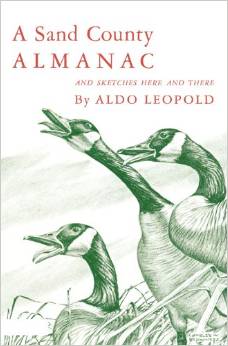
download1) A Sand County Almanac by Aldo Leopold: I first heard about this book from Dave Foreman when the original Earth First! Roadshow stopped in Berkeley. It was part of his stage performance (“The Speech”), specifically the story Leopold tells about encountering a wolf in the Gila Wilderness of New Mexico. Leopold was a young ranger and, as he put it, “full of trigger itch”. He and some other rangers were out on horseback when they saw a wolf and two cubs in the distance. I won’t spoil the story by telling what happened next, but it’s a famous story and has been retold many times.

A concept-heavy book with many great quotes and turns of thought, perhaps the most important one is this: “A thing is right when it tends to preserve the integrity, stability and beauty of the biotic community. It is wrong when it tends otherwise.” This book is known as a classic in its field, but I’m tempted to say that’s selling it short. It is literally without peer.

RobinsonJeffers

2) Selected Poems by Robinson Jeffers: This small book is a great read and very portable. There are anthology pieces like “Hurt Hawks” and “Shine, Perishing Republic”, as well as many others with the glorious imagery of the rugged California coast.

Jeffers is no simple nature poet, however, as he brings ideas into his poetry, ideas that have not proved popular with some people since he is critical of governments and the human species as a whole. You might think of him as a misanthrope who likes (some) people. He thinks humans are in general too full of themselves, consequently his philosophy he termed “inhumanism”—meaning, I take it, the opposite of “humanism”.

Today he would probably say he was a biocentrist, albeit one deeply distrustful of people. I recommend this book because of its many great poems but also its introduction to Jeffers’ thought, which is perhaps the fresher for being occasionally abrasive.

Abbey3) The Monkey Wrench Gang by Edward Abbey: Widely credited as the inspiration for Earth First! After getting my degree at San Francisco State and supporting myself playing tournament chess for a few years, I was running out of money so I decided to go back to school so I could take advantage of the G.I. Bill. I enrolled in Merritt College in Oakland and signed up for basically every science course they had. I took courses in biology, botany, marine biology, oceanography, geology, paleontology, astronomy, river studies, and desert studies.

One of the books on the reading list for Desert Studies was the acclaimed “Desert Solitaire” by Edward Abbey, which I enjoyed so much that when I finished I went to Cody’s Books (the late, great Berkeley bookstore) to see what else by the author I could find. As it happened the store had just got in a shipment of his latest book, a novel titled “The Monkey Wrench Gang”. It was like no book I had ever read, a comic, rollicking masterpiece about a pride of desert lovers driving around the Southwest, trying to save the desert that they loved. Needless to say the book made a great impression on me, as it did (it turned out) on many other people. Abbey, the thoughtful anarchist and social gadfly, created as memorable a cast of characters as you’ll find in a novel. It would be difficult to imagine an Earth First! appearing on the scene when it did, without it.

Bly
4) News of the Universe: Poems of Two-Fold Consciousness by Robert Bly. Looking back over my copy of this ground-breaking anthology I’m reminded of the piquant analysis of western history and thought, particularly as represented by the “Enlightenment”. Bly was getting at a biocentric way of thinking and writing. Bly says most people experienced the world before the Enlightenment as a place of wonder, but after the Enlightenment it became more and more just something to exploit. As Bly puts it, “more and more people were on that boat”. But then, Bly says, there was a push-back. The Romantic poets and others offered counter-argument, and though this remained a minority position for quite a while, given the state of the environment today it’s looking more and more like it’s the correct one.

Besides the essays scattered throughout the book developing these ideas, Bly showers us with poems (in English) from around the world. Poems from the Inuit, Navajo, European nations, and of course the Americas (North and South) show us that the “majority position” is by no means universally accepted. Much of the strength of this book comes from its multiculturalism.

EarthPrayers

5) Earth Prayers by Elizabeth Roberts, Elias Amidon: Like the Bly anthology, this collection ranges world-wide. Focuses on the spiritual side of things. This book was featured at a reading at Gaia Bookstore, a bookstore in Berkeley that no longer exists but was a favorite of mine. I met the authors there and gave them a copy of the Warrior Poet newsletter I had published. Elizabeth took one look at it and exclaimed “The Work!” That’s when I knew we were on the same page. Gaia bookstore’s name still exists in the Gaia building, which hosts the David Brower Center in downtown Berkeley.

Earth Prayers became a best-seller and remains in print. It is a good size for backpacking (always important to us nature lovers) and has many inspiring prayers and poems gathered from the world’s traditions. There’s also a good lead-in by the authors that give you a better sense of where they’re coming from. Suffice it to say, for them prayer was a way of coming to grips with the environmental crisis and overcoming the heavy sense of depression they felt as they saw nature’s systems crashing all around the world. The poems and prayers in the book are a way of re-connecting to the world, a way of healing the immense hurt that knowledge inflicts. Consequently the book isn’t a downer but a wise companion.

small-planet6) Poems for a Small Planet by Robert Pack, Jay Parini: An obvious take-off on the title of the famous “Diet for a Small Planet” by Frances Moore Lappe, the editors make no bones about why they put this book together. It’s the poets’ response to the environmental crisis.

This book is more like a standard poetry anthology. The poems in it are contemporary, with many familiar and unfamiliar names. What makes it different from the aforementioned books is the poets are all American, and all contemporary. There are introductions by both editors that seek to explain why they put the book together in the first place, and while that’s good, it’s their sure eye for picking out what to include that wins me over. Simply put, the poems are a look at what is being written today (well, at the time the book came out, at least), what people’s concerns were, the level of concern, how informed they were about the world around them. A little too big to take backpacking, it’s still an important addition to the warrior poets bookshelf.

JohnDaniel

7) Wild Song by John Daniel – As a longtime poetry editor for the Wilderness Society’s publication, the poems in his book are drawn from its pages. Anyone who edits a poetry section for an environmental magazine has to straddle two worlds – the world of poetry and the world of the environment. These poems, first published by the Wilderness Society, fit in neatly to the traditions of wilderness and wilderness protection in America. Poets submitting their poems to the magazine did it for a reason – they were attracted to its concerns and work. Consequently if the poems did get published, you know they were going to fit in with that tradition.

Daniel says the poems selected, “…decry ecological injuries, celebrate nature’s beauties and point to its many mysteries, and bear witness to our ever-available opportunity to recognize ourselves as rightful members of the evolutionary flow of earthly life.

John Daniel is one of very few long-term poetry editors in the field, and that gives this small volume a certain weight. Not the best dimensions for a back pocket, but it fits nicely into the side or front pocket of a backpack.

snyderolder
8) The Gary Snyder Reader: Prose, Poetry, and Translations: Gary Snyder is undoubtedly the most famous eco-poet of our time. He practically created the genre, and this book shows his thinking in both poetry and prose. As a treat, it even recounts the genesis of “Smokey the Bear Sutra”, Snyder’s blend of West, East, and Ecology all in one poem.

I picked this book to represent Snyder because it shows the range of his thought and writing skills better even than his selected poems, his Pulitzer Prize-winning “Turtle Island”, which I also could have chosen, or any of his other books, of which he has many. Anyone interested in a genre called “eco-poetry” absolutely has to experience Snyder’s work.

Swann

9) Poetry Comes Up Where it Can by Brian Swann: Brian edited, and I think still edits, the poetry section for The Amicus Journal (now OnEarth) for the NRDC. A terrific book, and very portable.

Brian Swann is the poetry editor of many years for Amicus (now OnEarth), the publication of the Natural Resources Defense Council. Brian details how he got the job in an amusing anecdote, and we are lucky he did since the two collections he created from its pages (this, with an introduction by Mary Oliver, is the second) are both keepers. Of the two, however, this is my favorite, probably because it has so many great poems in it I can’t find anyplace else, not to mention that it fits comfortably in the side pocket of my cargo pants.

Felstiner

10) Can Poetry Save The Earth? by John Felstiner: A scholarly look at American eco-poetry. This is a great book we celebrated at a tribute reading at the Berkeley Ecology Center. The book is more a scholarly work than it is a poetry anthology. So anyone looking for a scholarly approach to American eco-poetry will find this book an indispensable guide to the field. John will quote a few lines in writing about the poet, but then you will have to go to the library to get the rest of the poem. This may turn some readers off, but it does overcome the weakness of the “anthology” approach, which is to select a few favorites or anthology pieces when there is often much more to discover by the individual poet.

The answer to the title’s question is, not by itself, it can’t. But that’s beside the point. Poetry inspires people to act. Poetry also expresses deep-seated emotions, and sometimes those deep-seated emotions get turned into actions in the real world.

Nanao

11) How to Live on the Planet Earth by Nanao Sakaki – A close friend of Gary Snyder’s, poet, and vagabond, Nanao’s influence in this country is starting to grow; in his native Japan he is already well-known.

I met Nanao at a Rainforest Activists Conference in San Francisco at Fort Mason. He was on a panel and I don’t remember what he said but I remember him being there. I had come to hear him because I had read his book “Break the Mirror” published by Blackberry Press in Maine by Earth First! poet Gary Lawless. I thought it was terrific and wanted to meet him

Lawless published several other of Nanao’s books, and sadly, this is likely to be the last since Nanao, eternal wanderer, is now off walking the star road. Yet he leaves us these impressive poems where we can accompany him on many other walks, some as far away as the other side of the universe. (I should also mention he’s also very funny at times.)

ecopoetry12) Eco-Poetry Anthology by Ann Fisher-Worth, Laura Gray-Street: Finally somebody had to come out with this title. A hefty tome, not suitable for backpacking, but a substantial contribution to the emerging eco-canon.

This is the last book I’ll recommend here. Its breadth is simply breath-taking, and it follows the familiar formula of having an introduction by its editor or editors explaining their take on current eco-poetry, followed by the selections they have made. This is only the most recent contribution to the eco-poetry genre, so stay tuned! We’ll let you know as more cross the Warriorpoets desk.

–Dennis Fritzinger


Rendezvous Wrap-Up by Dennis Fritzinger

West Branch Campground
 
This year’s Round River Rendezvous (known affectionately as the rondy) was held at West Branch campground in Northern California, about 4 miles (so I hear) from Poker Flat.

Advantages of the site were:

1) easy to get to;

2) numerous campsites and workshop sites;

3) a cold creek running through it where we could cool off during the hottest days, and draw our drinking and washing water from (upstream from there).

Kitchen was well-organized and Morning Circles were well-run. Organizationally everything was very smooth.

 
West Branch Campground2
 
 
Several days were in the hundreds, and on those days the nights were warm enough to sleep without a sleeping bag until about 5 AM when things finally cooled off.

We also had a few cooler days for variety, and cooler nights. The entrance road made a big loop when you reached the main camp, and there was a latrine not far away so that was convenient.

Fire danger was high, and fires were only allowed in a few select spots, namely the rowdy campfire and kitchen area. Other spaces made use of tiki torches, and that worked just fine. Rowdy Campfire

There were a fair number of dogs, and that caused problems occasionally, but that’s about par for a rondy. Interpersonal relations generally went very smoothly, but the conflict team was available in case there was a need. Everyone was respectful of the need to keep intoxicants out of the public and family areas, so I didn’t see any problems there.

The rendezvous was multi-generational, from infants up through grandparents, and as far as I could tell everyone self-identified as an Earth First!er except for a reporter or two and a very small contingent of Green Anarchists. General impression? Earth First! is as young as it ever was, it’s only me that’s getting older.

People we know who were there: KP, Garlic, Karen Coulter, Gedden, Rod Coronado, Jonathan Paul, Dana Lyons, Tim Ingalsbee, Dave Parks, Andy Caffrey, Jim Flynn, Chris Manes, Dennis Davie.

Workshops I went to: Deep Ecology, hosted by Gedden, Karen Pickett, and Karen Coulter. Earth First! History, hosted by the two Karens. Ancient DNA, hosted by Dave Parks. Journal, hosted by the Journal Staff. And a workshop on the Mattole.

Mosquitoes? Yes. A few at breakfast, but most came at dinner-time. Except for mosquitoes, butterflies were the most numerous invertebrates. I also saw a dragonfly, a metallic wood-boring beetle with beautiful metallic green wing covers, and a small scorpion that glowed green under Dave Parks’ ultraviolet light.

There was the familiar dawn chorus of birds, but birds seemed to be mostly silent during the day, or maybe I was just too busy meeting people to notice them. Except for birds and humans, there were no vertebrates around that I noticed — no ground squirrels, chipmunks, deer, bears or any other.

Trees: Doug Fir, Hemlock, and Madrone. Understory: raspberries, poison oak, other.

Skies: a few clouds now and then. No rain.

Warrior Poets Society Meeting: four attended.

Welcome Back party for JP and Rod, Friday, July 4th, up at the rowdy fire. We had a good crowd.

Rally, Saturday, July 5th, first two hours were down where we had morning circle every morning, close to the camp kitchen. I tried out some new material. Then we had a break and moved up to the rowdy fire, where it went on into the wee hours. People seemed to enjoy both parts of the Rally. Part one was in a general space so it was alcohol free. Part two had a keg.

EarthFirst
 
Sunday was the Journal Workshop, as well as planning for the Action. I didn’t go to the Action planning so I have no idea where the Action was this year, though my guess is it was at both the Mattole and at Seneca Biomass burner in Eugene.

One thing different about this year’s rondy is the amount of attention we were getting from the LEOs. They were stopping nearly every car that came up, and some were even stopped twice. If they found the smallest infraction they’d search your car, at least that’s what I heard.

So there you have it. My Rendezvous report.

(I should also mention that I brought a bagful of copies of Roadkill on the Highway of Love with me, and in two days I had given them all away.)


Comments Off on Rendezvous Wrap-Up by Dennis Fritzinger

How Does A Warrior Poem Differ From A Nature Poem?

by Dennis Fritzinger

Someone said the poet’s role in an age of ecological catastrophe is to grieve. Just the knowledge of the changes the planet is going through produces pain and suffering in the poet and that’s how grieving or pain and suffering makes it into the poem, often in subtle, but sometimes not-so-subtle ways.

GreenManAnother thing that might happen is the poet puts on a mask and becomes a part of earth that is being diminished or even destroyed. The poet can give that “Other” a voice, much like in the Council of All Beings. The poet’s metamorphosis can produce a poem that couldn’t happen in the poet’s normal voice. It’s the difference between poetry and polemic.

In fact I often say that it’s a poet’s responsibility — the warrior poet’s job — to give a voice to the voiceless. Speak up! for nature, by letting nature speak up for itself.

Then there’s the grief part. What we feel in our personal lives, and that requires knowledge, can produce feelings of grief, even strong feelings of grief. These then can appear in the poems we write, either as a walk-on part or center stage. An entire poem may be a ritual of grieving. But, as I said, knowledge is necessary — you have to follow what’s going on (I read a lot) or be able to see it with your own eyes and think about it with your own brain.

So it’s important to process the information that comes to you. So important. Yet hard to do, there’s so much of it. And making sense of it–the processing–isn’t always easy. Being poets, we are language workers. Each of us has developed, or in process of developing, our own unique voice or way of saying things, which is all tangled up with our way of seeing things of course. And then there’s what we see and think about.

A lot of this flows out of our daily life. If we are lucky enough to have pursued a path in science, we’re half-way there already. But it doesn’t have to be science, it could be farming, or working as a forest ranger, or having any number of passions that involve the outdoors–surfing and rock-climbing, to name a few. Get the body involved, and the head will follow. Then the words will come.

Surfing
BearingWitness

That still leaves the question of where the line is between a nature poem and a warrior poem, since they both deal with nature. On one side of the divide there’s just nature in all its fecundity and beauty, nature as it would be if it was left alone by us. On the other side, there’s the human presence–everything we’ve done to alter the earth. That’s the raw material.

And we, as human beings, as poets, find it necessary at times to protest our own specie’s behavior. That’s when we express our grief, our anger, our outrage in our poetry. Or celebrate it, if for instance we have just joined together to take out a dam or cut a fishing net off a trapped whale.

At the very least we need to bear witness, like the Quakers. Warrior poetry is also a poetry of bearing witness.


Comments Off on How Does A Warrior Poem Differ From A Nature Poem?

Night To Howl & Round River Rendezvous Site Research

In early July for more than 30 years those who self-identify with the slogan “Earth First!” gather in a wild place to reconnect with old friends and meet new ones. It’s also where we have our not-so-annual “Night To Howl” warriorpoetry reading party around the campfire.

An essential part of this gathering is looking for an inspiring location… We’ve looked at two dozen sites all throughout the Klamath Knot region and will announce the agreed on location soon. In the meantime here’s maps and pics of one of the locations we looked at today: Grouse Creek Gap, Mt. Ashland

10320555_10152033209096986_5813881371175939837_n

MT. Ashland

10258899_10152033209431986_4154746110689222230_o

02-Hill Above Grouse Creek Gap

1798688_10152033189371986_5028859958181574055_n

10313671_10152033190006986_4502547906957227021_n

1512802_10152033192096986_4877085887427016638_n

10325318_10152033193206986_199513151330892668_n

10330359_10152033192121986_8520922942781706591_n

10346300_10152033191446986_2274118176783448909_n

10414608_10152033191501986_5636349982762079607_n

10369715_10152033193096986_7246180215189962446_n

10382774_10152033193066986_5532302703598377886_n

10411431_10152033192021986_5115124863392799223_n

10411921_10152033191556986_849954469831883528_n

10418283_10152033191181986_4326285503982602375_n

firstspring


Walkin’ Jim – Evangelist for Wilderness


Early days of Armed with Visions website was everpresent with Walkin’ Jim

Walkin_Jim2

Poems of a poet who has walked as far as John Muir:
Rock Dream, Bull River Woods, Bat Cave, and Joshua Tree.

walkin_jim_coloby Dennis Fritzinger

I first met Walkin’ Jim Stoltz at an Earth First! Rendezvous. A very tall, lean, lanky man with incredible musical talent, I had never heard of him before. Then, Earth First! was a magnet with a vision that drew incredible musical and other talents to it.

Walkin’ Jim was exceptional in many ways. An accomplished guitarist and songwriter with a twinkle in his eye, he had a singing voice that was like no other’s — deep, raspy, colorful, it was quite unlike his speaking voice. It reminded me of the canyons he sang about; there was a quality of wildness in it, a quality of the wilderness itself.

Jim would go on these many mile hikes and hike for hundreds, maybe thousands, of miles across the U.S. — through canyons, over mountains, across prairies — following rivers, daring mountain passes, surviving heat and snow and encounters with large animals, and he took it all in — he took every bit of it in. Jim was a minstrel for wilderness, an evangelist, and his songs, filled with stories and sounds, reflect that, and continue to inspire us to this day.

“In his lifetime, he accomplished numerous long-distance treks including the complete lengths of the Pacific Crest Trail, the Appalachian Trail, an east-to-west cross-continent hike, the entire U.S. Continental Divide, trips from Yellowstone to the Yukon, and many others. In total, he hiked more than 28,000 miles of long-distance trips.” –Legacy.com

Jim hiked more in a year than I have in my lifetime, and went more places than I ever dreamed of. As he was hiking a trail somewhere, a song would come to him and he’d sit down under a tree or on a rock and write it down. Or maybe he’d be sitting in the tent he put up at the end of a long day, and amid the preparation for dinner and sleep, he’d pick up his guitar and Jim_in_treestrum a few chords and suddenly a new song would start to materialize in his head and in the air around him. The trees, birds, and little animals that live in rocks got quite a few free concerts from Jim!

Of course Walkin’ Jim wasn’t always out there somewhere walking. Like a latter-day John Muir he would return to home base now and then. John Muir we associate with Yosemite, but home base for Muir was in the Bay Area. It was there he wrote his books and articles that became so influential. Jim’s base was with his family in Montana. That’s where he returned to rest up, to organize his latest songs and poems and share them first with friends and relatives, and to replenish. It was also where the schedule for his many singing tours began, complete with slide show and many slides. Thanks to the magic of photography, he could show his audience he wasn’t just making it up.

An evangelist has to evangelize, and to do that you have to entertain. Even more than a John Muir, Jim was a latter-day kokopelli traveling America’s heartland, though with a guitar instead of a flute. I make this comparison because kokopelli always has a backpack, though it’s hard to tell from the drawings if he was as tall.

Jim was able to entertain because he was a superb storyteller. Humorous, he had the sort of voice that could keep you rapt in attention, just as you would be if you were hearing it at a campfire. Jim had the ability to turn a large concert hall into an intimate space, much like a campfire. The slides and the songs would transport you, and he’d always throw in an appeal to write a letter in support of some place or critter somewhere that needed help. That’s the evangelist side of the entertainer.

When we lost Jim we lost a powerful presence, a powerful voice for the wilderness, and I lost a good friend.

The Kid for the Wild Scholarship is a tribute to the memory and vision of Walkin’ Jim Stoltz and his “kid for the wild” spirit.
Walkin_Jim


BC Wild Bears And Their Defenders

BearCoastTours
 
GrizzlyBears
 
     A poet in our warriorpoet online community is a tour guide of giant grizzly habitat in the wild’s of British Columbia. His name is Kiff Archer and you can read about the tours he offers here: bearcoasttours.com.

Sadly, trophy hunters are severely eliminating the hope of the Grizzly’s future by falsifying scientific data, as well as ignoring economic data that show eco-tours that peacefully visit bears generate way more revenue than trophy hunts that kill bears.

Most recently a huge area where bears were free from hunters has been opened up for killing. A month ago Kiff wrote:


Two Weeks Til Killing Sprees.

Protecting Bears lives.
Hearts just like ours.
Regardless of whys.
Their final hours.


Chilco Bears about to die.
Can’t help feeling inside.
Trophy killing guys.
Sauntering sunshine crimes.


The whole world cries.
For ancients eyes.
Those close by.
and from cities fly.


Old memories abound.
Bear caves underground.
Leaving scents behind.
Great Bears friends arrive.


-K

To learn more: “There is strong opposition from many indigenous groups, which have renewed calls for the government to respect tribal laws that ban the hunt on their traditional territories. They are not alone – recent poll data suggests that 80-90% of citizens in the province, including hunters who target other species, oppose the trophy hunt.”

Also: “The government claims that the decision to open the hunt and the kill quotas are ‘science-based’ but as Kyle Artelle writes, science doesn’t get a look in – and the Grizzlies’ are in serious danger.”


Comments Off on BC Wild Bears And Their Defenders